
Compliance – Part of Corporate Culture
˝At TI CONSULTING, I help organisations turn compliance requirements into clear, practical solutions that can be embedded into everyday business operations.˝
What does compliance really mean?
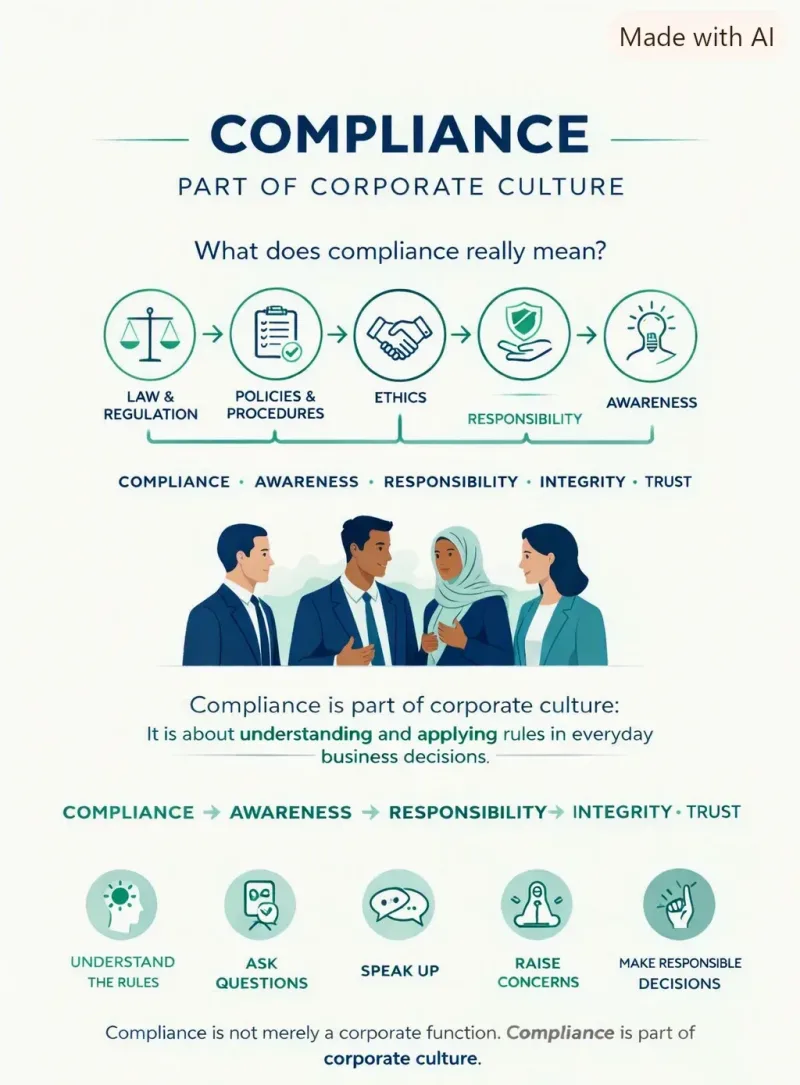
The word compliance essentially means conformity, adherence to rules, and meeting applicable requirements.
In a business context, however, it means much more than that.
Compliance means that an organisation operates lawfully, ethically, responsibly and consciously: complying with applicable laws and regulatory requirements, following its own internal policies and procedures, and upholding standards of ethical and responsible business conduct.
But compliance is not simply about having the right rules in place.
It is equally about:
understanding those rules, knowing how to apply them, and taking them into account when making everyday business decisions.
What if compliance does not begin when a new policy is issued?
What if it begins with the decisions we make every day?
In every organisation, there are situations for which no policy can provide a ready-made answer.
A business opportunity requires a quick decision.
A business partner proposes a condition that raises concerns.
An employee is unsure what the right course of action is.
This is where the real compliance culture of an organisation becomes visible.
What do we consider acceptable?
When do we say, “Let’s take a step back and look at this again”?
Do people feel comfortable asking questions when they are uncertain?
Will they speak up when something does not seem right?
And how does the organisation respond when someone does?
Compliance → Awareness → Responsibility → Integrity → Trust
A genuine compliance culture is not built simply through rules and controls.
It is built through awareness, accountability, consistent leadership, and integrity.
Effective policies and controls are important. But so are communication, training, leadership behaviour and the environment in which people are expected to apply the rules in practice.
Because compliance becomes truly effective when people do not simply know the rules, but understand why they matter, recognise potential risks, and know when to ask questions or seek guidance.
Leadership plays a critical role in this.
Tone from the top, consistent leadership behaviour, clear communication and a genuine Speak Up culture all send an important message:
Compliance is not about working against the business. It is part of responsible business.
That is why, for me, compliance is not a standalone corporate function.
Compliance is part of corporate culture.
It is part of a culture where people feel able to ask questions, seek guidance, raise concerns and challenge a business decision from a compliance perspective.
A culture where integrity is not simply a value displayed on a wall, but something reflected in everyday decisions.
And where rules are not merely restrictions, but a framework for safe, responsible and sustainable business operations.
This is the human and business side of compliance.
At TI CONSULTING, I help organisations turn compliance requirements into clear, practical solutions that can be embedded into everyday business operations.
Because good compliance is not about having as many rules as possible.
It is about enabling people to make responsible decisions — even when the situation is not black and white.
Would you like compliance to become a genuine part of your corporate culture?
Let’s talk about how TI CONSULTING can help you build a compliance framework and organisational culture that supports lawful, ethical and responsible business — while enabling your business objectives to move forward.
Compliance Consulting